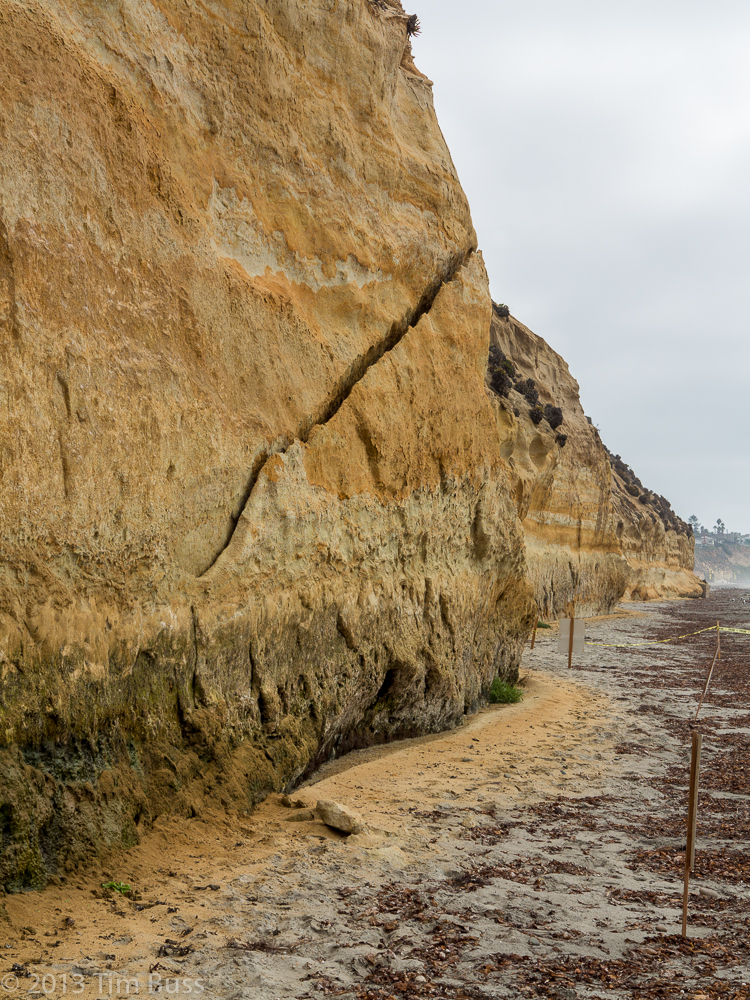
Erosion has shut down the Tamarack State Beach parking lot, and forecasters warn the worst is still ahead.
The lot has been closed to vehicles since early September and was fenced off to pedestrians in mid-October after waves and storm swells ripped away sand and scattered large rocks across the pavement, according to a city of Carlsbad update posted Oct. 16. California State Parks, which owns the lot and six of Carlsbad's seven miles of coastline, has hired a coastal engineer to plan repairs and hopes to finish the work by the end of December.
State Parks Lt. Sean Homer told the Carlsbad Environmental Sustainability Commission on Oct. 1 that project bids were expected in November, The Coast News reported.
Strong swells from Hurricane Genevieve stripped sand off the shoreline in August, blocking 35 parking spaces at the intersection of Tamarack Avenue and Carlsbad Boulevard. State Parks spokesman Jonathan Moreno said the sand loss, combined with wave action, caused the riprap protecting the shoreline to shift westward onto the beach, The Coast News reported.
The beach received 400,000 cubic yards of sand pumped from Agua Hedionda Lagoon dredging in February 2025. Much of that sand is gone.
Carlsbad City Councilmember Kevin Shin said local leaders are pressing the state for repairs, according to Fox 5 San Diego. Shin also said the city declared its own state of emergency because of how close erosion has come to Carlsbad Boulevard.
City Manager Geoff Patnoe wrote in an Oct. 15 update that the city is working to stabilize the bluff on south Carlsbad Boulevard north of the Las Encinas Creek bridge, where a geotechnical report recommended emergency measures. Because Tamarack is state property, the city does not have authority to lead repairs there.
What's coming this winter
Forecasters say this El Niño could be the strongest on record. NOAA reported a 100% chance of a strong El Niño through March and an 83% probability it will rank as the most powerful since modern records began in 1950, according to the Press Democrat, which first reported the forecast data.
European Centre for Medium-Range Weather Forecasts (ECMWF) model runs project 226% of normal rainfall for Southern California from January through March. Northern California's projection is 165% of normal over the same period.
A Kelvin wave, a slow-moving pulse of warm water beneath the ocean surface, is adding roughly 6 to 12 inches to sea levels off California, the Press Democrat reported. That elevated baseline, combined with king tides and storm swells, increases the potential for coastal flooding and further beach loss.
Eric Snortum, an oceanography and geology professor at MiraCosta College, told KPBS that the Kelvin wave could raise sea levels about 6 inches, enough to cause severe damage.
What Carlsbad is doing
The city said in a Sept. 3 update that it is coordinating with federal, state and local emergency managers, reviewing dam emergency plans, inspecting storm drains and preparing sandbags for residents. Swift water rescue teams and the Emergency Operations Center are on standby.
Carlsbad High School student Ella Rosenblum, a senior, told The Lancer Link student newspaper that the changes at the beach are visible. "I think since the water is warmer, the tide is getting high, and it's washing all the sand away, along with Tamarack," Rosenblum said.
Residents can sign up for San Diego County emergency alerts and find flood preparation tips at ready.ca.gov. The city asks anyone who encounters a flooded road to turn around and not attempt to cross.